
What modular MEV actually means
Maximal Extractable Value (MEV) is the profit that validators, sequencers, or searchers earn by inserting, reordering, or excluding transactions within a block. Traditionally, this extraction happened in monolithic networks where a single chain handled data availability, sequencing, and execution all at once. In that model, the entity controlling the block had a monopoly on value extraction, often leading to congestion and unpredictable fees for users.
Modular MEV breaks this process apart. Instead of one chain doing everything, specialized layers now handle specific tasks. Data availability is managed by one network, sequencing by another, and execution by a third. This separation means that value extraction is no longer a single, centralized event. Instead, it is distributed across a stack of specialized protocols.
This shift changes the economics of profit extraction. Competition for MEV now happens across different layers rather than just within one block producer. As modular blockchains become more popular, the dynamics of MEV competition evolve. Searchers must navigate a more complex landscape, coordinating across data, sequencing, and execution layers to capture value. This structure can reduce the monopoly power of traditional block builders and create new opportunities for efficiency, though it also introduces new coordination challenges.
The new MEV supply chain layers
Modular MEV breaks the monolithic blockchain model into distinct functional layers. Instead of a single node handling data, sequencing, and execution, the workload is distributed. This separation allows specialized networks to optimize for specific tasks, creating a new supply chain where value is captured at different stages of the transaction lifecycle.
Data availability and settlement
Data Availability (DA) layers solve the storage bottleneck for rollups. By offloading data to cheaper, specialized networks, rollups can scale transaction throughput without congesting the main settlement layer. However, this introduces a new point of contention. Searchers now compete for access to this raw data stream. If a DA layer delays publishing data, it creates a window where transaction order is uncertain, allowing sophisticated actors to front-run or sandwich trades before the data is fully settled and immutable.
Shared sequencers
Shared sequencers offer a coordinated path for transactions from multiple rollups to enter the same execution environment. This reduces latency and improves price discovery across chains. However, it creates significant coordination problems for MEV searchers. Because a single sequencer processes bundles from different sources, it becomes a central point of control. Searchers must navigate complex bundling strategies to ensure their transactions are included without being reordered by the sequencer or other competing searchers targeting the same liquidity pools.
Specialized execution environments
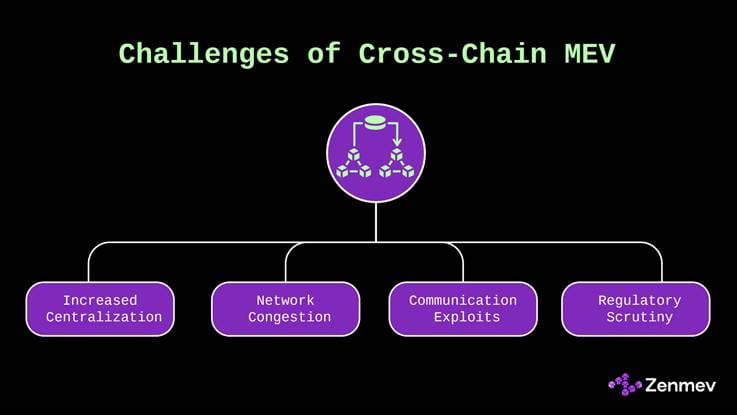
Execution layers are becoming increasingly specialized. Some chains focus on high-frequency trading, others on privacy, and some on low-cost social transactions. This fragmentation means MEV is no longer just about reordering transactions within a single block. It involves cross-chain arbitrage and state synchronization. A searcher might extract value by exploiting the time delay between a transaction being executed on one chain and its state being reflected on another. This cross-domain MEV requires tools that can monitor multiple chains simultaneously, turning MEV extraction into a complex, multi-layered engineering challenge.
How specialized Layer 1s compete
New Layer 1 blockchains are moving away from Ethereum’s general-purpose model by optimizing their core architecture for specific verticals. These chains are built for distinct use cases—such as high-frequency gaming, AI computation, or private transactions—creating MEV landscapes that function differently than the competitive auction markets seen on Ethereum.
On Ethereum, MEV is primarily extracted through complex ordering of transactions in a shared mempool, often leading to congestion and high fees for regular users. In contrast, specialized L1s can embed MEV extraction directly into their consensus or sequencer layers. This structural shift changes who captures value and how it impacts network stability.
The table below compares how MEV manifests across a general-purpose chain and two specialized architectures.
| Chain Type | Primary MEV Source | Sequencer Influence | User Experience |
|---|---|---|---|
| General-Purpose (e.g., Ethereum) | Arbitrage, liquidations, sandwich attacks | Minimal (proposer-builder separation) | High volatility, front-running risk |
| High-Frequency (e.g., Gaming/DeFi) | Block packing, priority fees | High (centralized or trusted) | Fast finality, potential censorship |
| Privacy-Focused (e.g., ZK-based) | Encrypted mempool, private transactions | Limited (obfuscated data) | Reduced front-running, lower transparency |
This divergence highlights a structural economic shift. As specialized L1s compete for developers and users, they must balance MEV extraction with network neutrality. While some models prioritize speed and low costs by centralizing sequencing, others use cryptographic tools to mitigate extraction risks. The result is a fragmented ecosystem where the "best" chain depends on whether a user prioritizes transparency, speed, or privacy.
For further reading on the mechanics of these innovations, see Signum Capital’s primer on MEV innovation, which details how modular architectures are adapting to these competitive pressures.
Decentralized searchers and builders
The modular MEV landscape has shifted from a centralized monopoly to a distributed network of specialized actors. In this era, searchers no longer rely on a single, opaque builder to package their transactions. Instead, they interact with modular relays—open-source infrastructure that acts as a neutral marketplace for block space. This structure allows independent builders to compete for transaction flow, preventing any single entity from capturing the entire value chain.
Searchers operate by submitting their transaction bundles to these relays. The relay then forwards these bundles to multiple builders, who compete to include them in the next block. This competition drives up the price searchers are willing to pay, ensuring that value is extracted efficiently and transparently. The process is similar to an auction house where the highest bidder wins the right to execute a trade, but the auction itself is public and verifiable.
This decentralization reduces the risk of censorship and collusion. When builders are independent and relays are open-source, it becomes significantly harder for any single actor to manipulate the order of transactions for unfair advantage. The Flashbots Collective has long advocated for this modular approach, emphasizing that open relays and diverse builders create a more resilient ecosystem for MEV extraction Flashbots Collective. As specialized L1s emerge, this dynamic will likely intensify, further distributing power across the network.
Cross-domain MEV and finality
The modular stack has created a new frontier for value extraction: cross-domain MEV. Unlike traditional MEV, which is confined to a single blockchain’s mempool, cross-domain MEV occurs when a transaction on one chain triggers an effect on another. As Maven11 notes, this dynamic allows extractors to capture value based on state changes that ripple across the modular ecosystem.
This phenomenon is particularly acute in the realm of finality. When a rollup finalizes a block, that state must be communicated to the settlement layer or other dependent chains. Extractors monitor these bridges and state proofs, looking for inefficiencies in how cross-chain messages are processed. A delay in finality or a mismatch in state updates can create a window for arbitrage or sandwich attacks that span multiple networks.
The risk is structural. Because different layers operate on different timelines and consensus mechanisms, a transaction might be considered "final" on a rollup but not yet settled on the L1. Searchers exploit these gaps, front-running or back-running transactions based on anticipated state transitions. This creates a complex web of dependencies where profit is extracted not just from user intent, but from the mechanical friction between chains.
As the modular thesis matures, the definition of a "block" becomes less relevant. The battlefield shifts to the inter-chain communication layer. For validators and searchers, the ability to predict and react to cross-domain state changes will define the next generation of MEV strategies.
No comments yet. Be the first to share your thoughts!