
modular mev 2026 stack overview
Modular MEV 2026 redefines blockchain value capture by decoupling the three core functions of a blockchain: sequencing, execution, and settlement. In the monolithic model, these layers were bundled together, creating bottlenecks and limiting optimization. The modular approach allows each layer to specialize, enabling L2s to compete on sequencing quality and execution efficiency rather than just raw throughput.
At the center of this architecture is the sequencer, which orders transactions before they are executed. Unlike monolithic L1s where the validator also sequences, modular L2s often use dedicated sequencers or shared sequencing services. This separation allows for more sophisticated ordering strategies, such as priority gas auctions or custom order flow APIs, which are critical for searcher profitability in 2026.
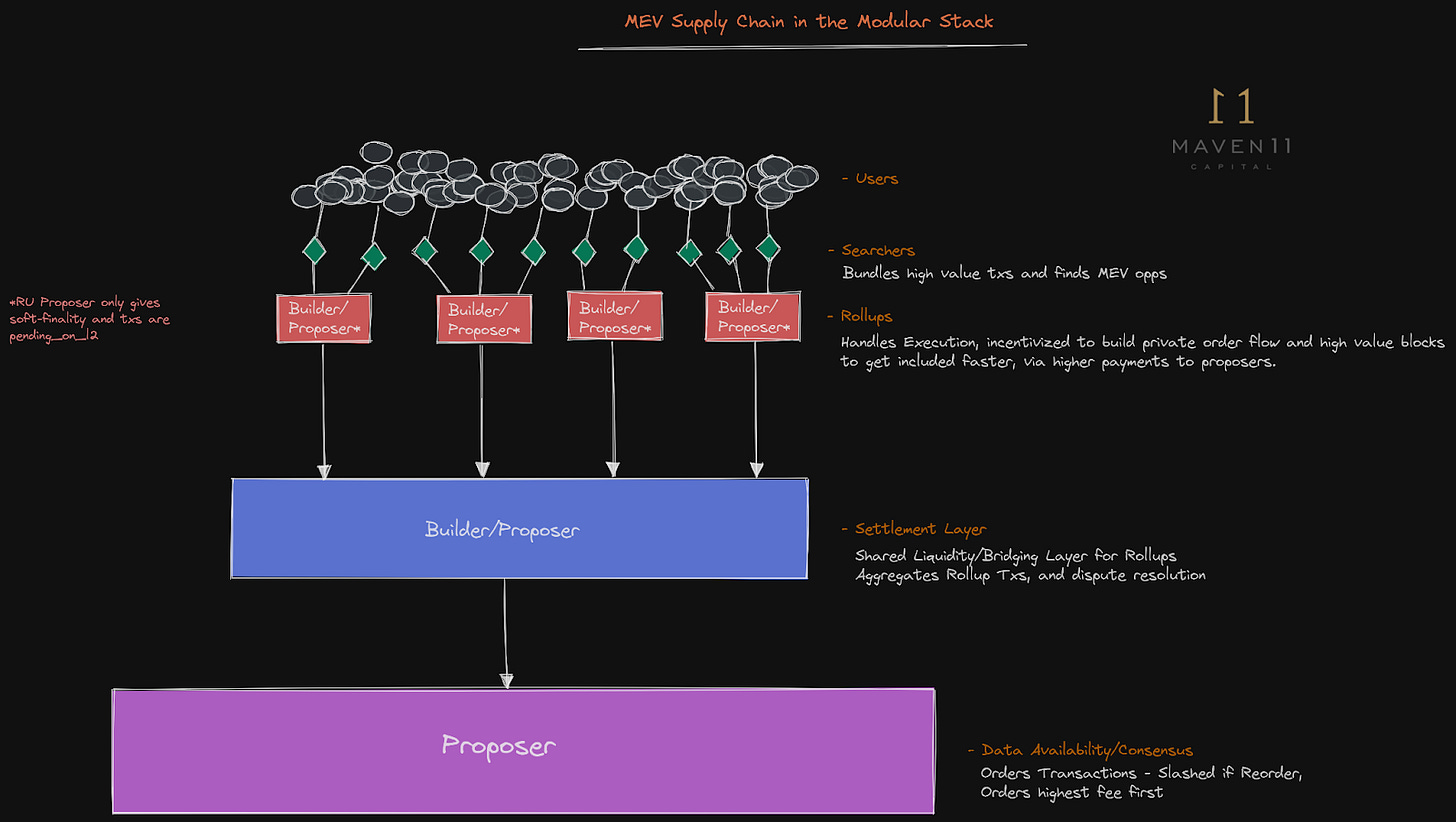
Execution layers, typically L2 rollups, process the ordered transactions and generate state proofs. The settlement layer, often an L1 like Ethereum, finalizes these proofs. This separation means that MEV opportunities can be captured at different points in the stack. For instance, a searcher might focus on execution-layer MEV (like arbitrage on an L2 DEX) or sequencing-layer MEV (like front-running transactions before they hit the L2).
The profitability of modular MEV 2026 depends on how efficiently these layers communicate. Faster finality and lower data availability costs increase the window for profitable execution. Searchers must now manage a more complex landscape, where strategy involves not just finding arbitrage opportunities, but also optimizing for the specific constraints of the sequencing and settlement layers.
L2 MEV strategies compared
Modular MEV 2026 shifts the battlefield from simple transaction ordering to architectural design. As Layer 2 networks mature, the choice of sequencing model dictates who captures value and how much latency cost they incur. The three dominant approaches—Proposer-Builder Separation (PBS), Centralized Sequencing, and Decentralized Sequencing—offer distinct trade-offs in revenue potential, censorship resistance, and operational complexity.
Proposer-Builder Separation
PBS fragments the block production process, allowing specialized builders to compete for the right to include transactions. This model maximizes revenue for sophisticated searchers who can bid on block space, but it introduces significant latency due to the extra communication layer between proposers and builders. It is the preferred strategy for high-frequency trading bots that prioritize execution speed over block inclusion certainty.
Centralized Sequencing
Centralized sequencing relies on a single operator to order transactions within a block. This approach offers the lowest latency and highest throughput, making it ideal for applications requiring deterministic finality, such as gaming or instant settlement. However, it concentrates censorship power in the hands of the sequencer, often resulting in lower overall MEV extraction for external searchers who cannot compete with the internal order flow.
Decentralized Sequencing
Decentralized sequencing distributes the ordering responsibility across a network of nodes. While this enhances censorship resistance and aligns with the ethos of permissionless finance, it typically suffers from higher latency and lower revenue per transaction compared to centralized models. It is best suited for protocols where trust minimization is more valuable than raw execution speed.
| Strategy | Latency Impact | Revenue Potential | Censorship Resistance |
|---|---|---|---|
| PBS | High | High | Medium |
| Centralized | Low | Low-Medium | Low |
| Decentralized | Medium | Medium | High |
Profitability by Approach
Profitability in modular MEV 2026 is not uniform. Centralized sequencers capture value through internal order flow, often bypassing external searchers entirely. PBS models create a marketplace where searchers pay premiums for inclusion, driving up costs but also revenue for builders. Decentralized models rely on volume and community incentives, offering lower per-transaction margins but higher stability against regulatory or technical shocks.
| Strategy | Latency | Revenue | Censorship Resistance |
|---|---|---|---|
| PBS | High | High | Medium |
| Centralized | Low | Low-Medium | Low |
| Decentralized | Medium | Medium | High |
Calculating Your MEV Edge
To estimate potential returns, consider the trade-off between latency and revenue. Faster execution (Centralized) may reduce your ability to compete in open markets, while slower execution (PBS) allows for more complex strategies but increases the risk of being front-run by faster actors. Use the calculator below to model how latency impacts your expected MEV capture.
Key Takeaways
- PBS offers the highest revenue potential but requires sophisticated infrastructure.
- Centralized sequencing is best for low-latency, high-throughput applications.
- Decentralized sequencing provides the strongest censorship resistance but lower margins.
- Your strategy should align with your risk tolerance and technical capabilities.
Searcher profitability calculator
Estimating net profitability in a modular MEV 2026 environment requires isolating the specific costs of sequencing and gas against your capture rate. This calculator helps you model whether the overhead of building a dedicated sequencer or using a high-fee L2 is justified by the value you extract.
Enter your expected block value, average gas burn, and the sequencing fees you must pay to the builder. The tool subtracts these hard costs from your gross MEV capture to show your actual net profit per block.
Use this output to benchmark your strategy. If the net profit is negative, consider reducing your gas spend or targeting less congested windows. In modular architectures, sequencing fees are the new fixed cost; your edge must come from efficiency, not just volume.
Decentralized sequencer choices that change the plan
The shift toward decentralized sequencers in 2026 introduces a fundamental tension for modular MEV extraction: latency versus censorship resistance. Traditional centralized sequencers offer speed but create single points of failure and censorship risk. Decentralized alternatives distribute this power, but often at the cost of increased transaction finality times.
For searchers, this means rethinking how value is accrued. In a modular stack, the separation of execution and consensus allows for more robust MEV strategies, but the sequencer layer remains the bottleneck. If the sequencer is slow, front-running opportunities vanish. If it is too slow to prevent censorship, MEV becomes unpredictable.
The 2026 landscape demands a precise calculation of these tradeoffs. Searchers are no longer just competing on code; they are competing on infrastructure resilience. The modular approach allows for specialized sequencers, but the cost of failure is higher when the stack is distributed.
calculating the cost of censorship resistance
Decentralized sequencers often require additional cryptographic proofs or multi-party computation to ensure fairness. This adds computational overhead. For a searcher, this overhead translates directly into higher gas costs or slower execution.
Use this calculator to estimate the potential impact of sequencer latency on your MEV strategy. Input your average transaction value and the additional latency (in milliseconds) introduced by a decentralized sequencer compared to a centralized one.
Note: This is a simplified model. The formula assumes a 10% probability of missed MEV opportunity per 100ms of latency. Actual losses depend on market volatility and competitor behavior.
when to choose which sequencer
The choice between centralized and decentralized sequencers depends on your specific MEV vector. Arbitrageurs, who rely on speed, may still prefer centralized options despite censorship risks. Long-term value accrual strategies, which prioritize security and decentralization, may benefit from the resilience of decentralized sequencers.
MEV-Boost alternatives for L2s
The standard MEV-Boost relay architecture, designed for Ethereum mainnet, often introduces latency and centralization risks that are unacceptable for high-frequency Layer 2 operations. In 2026, modular MEV strategies increasingly rely on custom builder networks and localized ordering protocols to capture value within specific L2 ecosystems. These alternatives reduce the hop count between transaction inclusion and block production, allowing searchers to compete on speed rather than just capital.
Custom builder networks operate as closed-loop systems where validators and builders are tightly integrated. This structure eliminates the need for external relays, reducing the attack surface for censorship or front-running by third-party operators. For L2s with high transaction throughput, this direct pipeline ensures that MEV extraction does not bottleneck the sequencer. The trade-off is reduced decentralization, as the network relies on a smaller set of trusted infrastructure providers.
Localized ordering protocols, such as those embedded in optimistic rollup sequencers, allow for intra-block MEV extraction. Instead of waiting for a block to be finalized and then auctioned, these protocols order transactions based on priority fees or specific arbitrage opportunities in real-time. This approach captures value that would otherwise be lost to the mainnet relay auction. Searchers must adapt their bots to interact directly with the L2 sequencer rather than the mainnet mempool.
L2 MEV profit calculator
Estimating profitability requires comparing the gross MEV extracted against the costs of maintaining a specialized L2 infrastructure. Use the calculator below to model your potential returns based on transaction volume and fee structures.
No comments yet. Be the first to share your thoughts!