

Why modular MEV matters now
The landscape of Maximal Extractable Value (MEV) has fundamentally shifted from monolithic block-building to a modular architecture. In the past, searchers operated within a single chain’s execution layer, competing for space in a limited block size. Today, the separation of consensus, execution, and data availability layers has created new vectors for value extraction that monolithic tools cannot address.
This shift is driven by the rise of cross-domain interactions. As Maven11 Research notes, cross-domain MEV occurs when transactions on one chain trigger effects on another, allowing searchers to capture value on the destination chain. This requires infrastructure that can monitor multiple chains simultaneously and react to state changes across different consensus layers, a capability far beyond the scope of traditional single-chain bots.
Decentralized sequencing further complicates the environment. With rollups and modular blockchains often relying on decentralized sequencers or alternative data availability networks, the timing and ordering of transactions become less predictable. Searchers must now account for the latency and reliability of these separate layers, optimizing their strategies for cross-chain finality rather than just block inclusion.
For developers and searchers, this means legacy tools are insufficient. The new paradigm demands infrastructure that can handle cross-chain data propagation, modular block construction, and decentralized sequencing signals. The ability to capture value in this modular ecosystem depends on how well your tools manage the complexity of separated blockchain layers.
Top modular MEV relays and builders
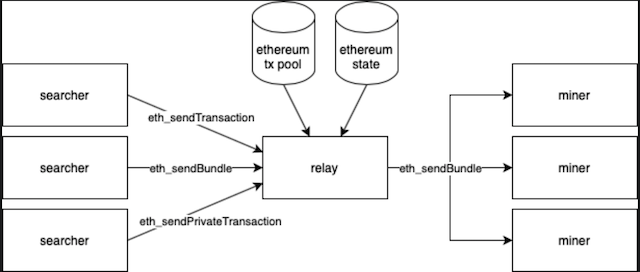
Modular MEV separates the extraction of value from the block production process. This separation relies on a chain of specialized infrastructure: searchers build bundles, relays transmit them to builders, and builders assemble the final block. For 2026, the performance of this pipeline depends on low-latency relays and builders that support cross-domain bundles and advanced ordering rules.
The relay layer acts as the critical bottleneck. If a relay is slow or lacks support for complex bundle types, searchers lose arbitrage opportunities before the builder even sees the transaction. Modern relays written in Rust or optimized Go frameworks are becoming the standard for high-frequency trading environments where microseconds matter.
Builders like Titan and Flashbots have adapted to this modular shift. Titan, for instance, has released new modular MEV-Boost relays written in Rust to improve throughput. These builders must handle not just Ethereum mainnet bundles, but increasingly, cross-domain MEV from Layer 2s and other chains. The ability to process these diverse inputs without dropping bundles is a primary differentiator in 2026.
To evaluate which infrastructure fits your search strategy, compare the core technical specifications of the leading relay and builder implementations below. Focus on language, latency, and bundle support rather than just uptime.
Running this infrastructure requires robust local hardware. While the software is the primary focus, the physical nodes that host your relays and builders must handle high I/O operations. Consider the following server hardware and security tools to support your search operations.

As an Amazon Associate, we may earn from qualifying purchases.
Cross-Domain and Shared Sequencer Infrastructure
Capturing value across modular stacks requires more than just fast block builders. A transaction on one chain can trigger effects on another, creating a capture opportunity on the destination chain. This creates a complex dependency chain where searchers must monitor state changes across disjointed ledgers to identify arbitrage or liquidation events before they are finalized.
Shared sequencers introduce a different layer of complexity. By allowing multiple rollups to share a single ordering layer, these tools can reduce latency and increase transaction throughput. However, the implementation details vary significantly. Depending on the specific sequencer architecture and rollup configuration, shared sequencing may offer more or less MEV extraction potential than traditional private ordering. Searchers need tools that can interface directly with these shared ordering layers to detect bundled transactions in real-time.
The infrastructure for this niche is specialized. You need middleware that can subscribe to cross-chain message passing protocols and translate those events into actionable trading signals. Generic MEV bots often fail here because they lack the deep integration required to parse shared sequencer payloads or cross-chain bridge events.
MEV protection plugins for DEXs
MEV protection is no longer just a feature; it is a standalone product layer within the modular MEV ecosystem. This shift allows decentralized exchanges to integrate security directly into their routing logic without rebuilding the entire infrastructure from scratch.
A primary example of this modular approach is the collaboration between Reflex and Algebra Integral. They have developed an MEV protection plugin designed to be deployable across any DEX powered by the Algebra framework. This integration turns MEV extraction into shared value rather than a zero-sum game for individual users.
For developers and searchers, these plugins act as a critical buffer. They intercept sandwich attacks and front-running attempts before the trade is finalized, ensuring that the execution price remains fair. This modularity means that DEXs can adopt protection mechanisms incrementally, testing efficacy without disrupting existing liquidity pools.
The ability to plug in protection tools directly addresses the trust deficit in decentralized trading. By making MEV resistance a configurable component, the ecosystem moves toward a standard where security is a baseline requirement for all participants, not an optional add-on.
FAQs about modular MEV infrastructure
How does cross-domain MEV change latency requirements?
Cross-domain MEV involves transactions on one chain triggering effects on another, creating capture opportunities across the modular stack. Because searchers must process finality signals from separate execution and data availability layers, the latency window is often tighter than on monolithic chains. Infrastructure must prioritize low-latency RPC connections to both the rollup sequencer and the DA layer to capture these arbitrage opportunities before they expire.
What are the biggest technical hurdles in modular MEV setup?
The primary challenge is managing the complexity of multiple data sources. Searchers must synchronize state from execution layers with data availability proofs, which introduces synchronization delays. Shared sequencers can mitigate some ordering issues, but their implementation varies by rollup. Developers need robust middleware to handle these discrepancies and ensure their bots react to on-chain events with minimal delay.
How should I choose tools for a modular MEV stack?
Select infrastructure based on your specific target domain. If you are focusing on L2 MEV, prioritize tools that offer direct access to the sequencer’s mempool. For cross-chain strategies, look for solutions that support multi-chain RPC aggregation and fast cross-domain message parsing. Avoid generic MEV bots that do not explicitly support the modular architecture you are targeting, as they often lack the necessary hooks for DA layer integration.
No comments yet. Be the first to share your thoughts!